


The bot answers fast, then stalls.

By Elizabeth Ndungu | Founder, Ndungu Consulting | Tech Coach for Adults 50+
AI customer service frustration can make a simple phone call feel like a test.
You call about a bill, a prescription, a delivery, or an account.
A voice answers right away — you feel relief because someone picked up immediately, then they ask you to describe the issue.
You explain.
And as they talk you realize, not again! not a machine! not AI AGAIN!!!! GRRRRRRRRRR!!!!
It gets the issue wrong.
Then it asks you to explain again.
Or, picture someone standing in a pharmacy parking lot, trying to find out why a prescription was denied. The medicine is inside. The person needs an answer from the insurance line before they can pick it up. But the bot keeps asking them to repeat the issue. The help is there, but the machine is blocking the path to it.
That is not a small annoyance. That is an access problem. The bot is standing between people and their bills, prescriptions, accounts, and insurance.
Why This Feels So Annoying
Old phone menus were limited, but clear.
Press 1 for billing. Press 2 for claims. Press 3 for support.
AI systems promise something better. They ask you to speak in your own words.
That sounds helpful until the system misunderstands you.
Then the problem changes.
You are no longer only trying to fix the bill or prescription. You are trying to figure out what phrase the machine will accept.
That is frustrating for many people, not only older adults. Lets not even get into accents either.
Why Companies Use These Systems
Companies use automated systems for a simple reason: one bot can answer many calls at once, route simple tasks, and cut the number of calls that reach a live person.
That may help the company. It may help you too, when the task is simple.
But when the issue has context, urgency, stress, or a special exception, a person can be better. A bot collects details. A person understands why those details matter.

What to Try Before You Give Up
No phrase works with every system.
Still, short phrases often work better than full explanations.
Try:
- Agent
- Representative
- Speak to a person
- Complaint
- Billing problem
- Cancel service
- Technical support
- Fraud concern
- Account locked
Say the phrase clearly.
Then stop talking.
If the system uses a keypad, try pressing 0.
If that fails, try again after the next prompt.
Some systems route differently after repeated failed attempts.
Keep Your Explanation Short
When the system asks what you need, do not tell the full story first.
Use a short phrase.
Instead of:
“I went to the pharmacy and they said my medication was denied even though I have taken it for years and I do not understand what changed.”
Try:
“Prescription denied.”
Instead of:
“I paid this bill two weeks ago, and now the company says I still owe money.”
Try:
“Billing error.”
You can give the full explanation when you reach a person.
The shorter phrase is only to get through the system.
A Common Call Pattern
Here is how these calls often go.
A customer calls with a real problem. The bot asks them to explain, so they use a full sentence, because that is what the system requested.
The bot pulls out the wrong word and sends them down the wrong path. The customer says “human,” but the system asks for more detail.
After several minutes, the person hangs up or starts over. The call started with one problem. Now it has two: the original issue, plus the frustration of getting nowhere.
Before You Call
Prepare as much as you can.
Write down:
- Your account number
- Your claim number or bill number
- The date of the problem
- The name of the company
- The exact result you need
Then write your main sentence.
Example:
“I am calling because my prescription was denied, and I need to know what step fixes it today.”
Keep that paper near you.
When you reach a person, read the sentence first.
Safety Warning
Most automated phone systems are annoying, not scams. But scammers copy real customer service language.
Be careful when someone calls you first and asks for private information. A real company should not unexpectedly call and demand your full Social Security number, full card number, password, or one-time code.
If you are unsure, hang up. Call the company using the number printed on your card, bill, or official statement.
The rule is simple: give private information only when you called the company through a number you already trust, and only when the request makes sense.
If the company called you first, verify separately. That means confirming the company’s real contact information yourself, from the back of your bank card, a paper statement, or your official app, not from a number the caller gave you and not from a random search result. Search pages can show ads, fake support numbers, and scam sites right at the top.
Is AI Customer Service Safe for Adults Over 50?
AI tools including those customer service AI agents, ChatGPT, Claude, and Gemini make mistakes. They can state incorrect information confidently and without flagging it as uncertain. Always verify anything important, especially in medical, legal, financial, or safety contexts, through a qualified professional or a verified source. These tools are aids for thinking and drafting, not authoritative sources.
Your Patience Is Not the Problem
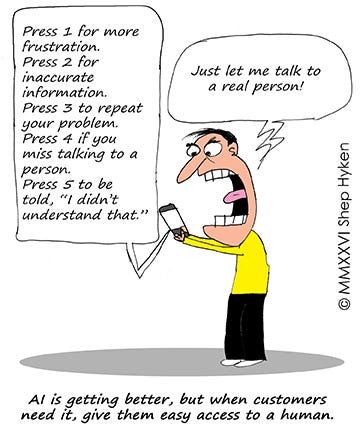
Since I help a lot of older adults with technology I want to assure you, YOU ARE NOT THE PROBLEM, the system is the problem!
You are not behind because a bot misunderstood you.
The system is very poorly designed, and is constantly being worked on.
Many people have the same frustration. Research on customer service in 2026 still shows a strong preference for live agents when people need support.
That does not mean automation has no place.
It means we need a clear exit when the bot fails.
You deserve that exit.
Try the short phrase. Press 0 or 9 if it is available. Call back if the loop gets worse.
The maze was built by the company.
Not by you.
I write regularly about technology, safety and digital literacy for adults over 50. Following me here on Medium is the best way to see the next piece when it comes out.
For calm, one-on-one technology help with no pressure, no jargon, and no embarrassment, visit ndunguconsulting.com.
About the Author
Elizabeth Ndungu is the founder of Ndungu Consulting, a technology coaching and digital literacy practice that helps adults over 50 build confidence with everyday technology. Computers, phones, AI tools, email, Microsoft Office, online safety, and digital skills in plain English. She provides patient, practical support for people who want to learn without jargon, pressure, or embarrassment.
Sources
Shep Hyken, “Ten AI Customer Service Statistics for 2026 That Will Shape Your CX Strategy,” March 2026: https://hyken.com/customer-service-strategies/ten-ai-customer-service-statistics-for-2026-that-will-shape-your-cx-strategy-ten-ai-customer-service-statistics-for-2026/
Forbes, “Human-Centered Service In The Age Of AI,” March 2026: https://www.forbes.com/sites/shephyken/2026/03/08/human-centered-service-in-the-age-of-ai/
Leave a Reply