


A story about one student, one small mistake, and the moment everything started to make sense.

Linda* wasn’t afraid of hard work.
She was in law school in her 60s, managing court documents, meeting deadlines, and learning systems that were never designed with her in mind. What made her pause wasn’t the work itself. It was the pressure of getting everything right.
Because in her world, small mistakes are not small.
A document saved in the wrong place.
A file uploaded incorrectly.
A missing signature. Those things matter.
So when we started working together, AI was not even part of the conversation. We focused on structure. Where files go. How to name them. How to upload them correctly. How to check they were received. We worked slowly, repeating the same steps until they felt familiar.
That was the goal. Calm. Clear. Repeatable.
Then one day, we tried something different.
I asked her to upload a document into ChatGPT and ask a simple question: “Can you tell me if this document has a signature?”
It responded quickly. Confidently.
But it wasn’t quite right.
She didn’t panic. She didn’t dismiss it either. She just paused and said, “Let’s try it somewhere else.”
So we opened a second AI tool and asked the same question.
This time, the answer was different. Better.
That was the moment everything shifted.
Not because AI suddenly became perfect. But because she understood something deeper. She realized she didn’t have to rely on one answer. She could compare. She could check. She could stay in control.
That changes everything.
After that session, her whole approach evolved. She began using AI to review documents before uploading them. She used it to explain confusing instructions in plain language. When something didn’t make sense, she asked again, or asked somewhere else. She stopped second-guessing herself and started verifying instead.
That is real confidence. Not knowing everything. Knowing what to do next.

Linda is not the only one.
James* came to our sessions with decades behind him. He had recently retired after a long career in historical research and legal writing, and he had three nearly finished manuscripts sitting on his hard drive. He was not new to careful work. He had spent years checking facts, dates, and legal language for accuracy.
What he was new to was trusting a tool he could not fully see inside.
In one of our early sessions, we used Copilot to summarize a 143-page manuscript. The summary came back quickly. It was confident. And when we read it against the original, something was off. A key argument had been flattened. A date was soft.
James didn’t dismiss it. He said, “Let’s try it with a different tool and compare.” He already understood the principle from a lifetime of cross-checking sources. We were just applying it somewhere new.
So we ran the same document through ChatGPT. The second summary caught what the first had missed. We built a simple two-column comparison and he could see exactly where the gaps were. After that, cross-checking became part of his workflow, the same discipline he had always brought to his research, now extended to the tools helping him finish it.
The problem was never the technology. It was that nobody had shown him how to stay in charge of it.
What worked for both Linda and James came down to three habits they kept returning to: ask clearly, check answers, stay in control.
Simple. But only obvious once someone walks you through it.
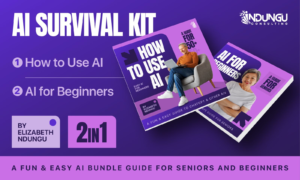
That is exactly why I created the AI Survival Kit. What they learned in those sessions is something you should not have to struggle to figure out alone.
The guide walks you through what we practiced together, step by step. What to type. What to look for. What to double-check. How to stay safe. How to avoid the mistakes that cause the most frustration. It is practical, plain-language, and designed for people who want to use AI without feeling rushed or overwhelmed.

Linda still works carefully. She still checks her documents. That has not changed.
What has changed is how she feels while doing it.
She no longer worries about uploading the wrong thing. She knows how to check. She knows what to do next. That kind of clarity removes stress, saves time, and gives you back control.
If you want that same clarity, you can get the AI Survival Kit here:
elizabethw2.gumroad.com/l/AIsurvivalkit
Or if you would rather have someone walk you through it personally:
Learn more here:
or book a session directly:
ndunguconsulting.as.me

You do not need to figure this out alone.
*Names changed to protect client privacy.
Leave a Reply